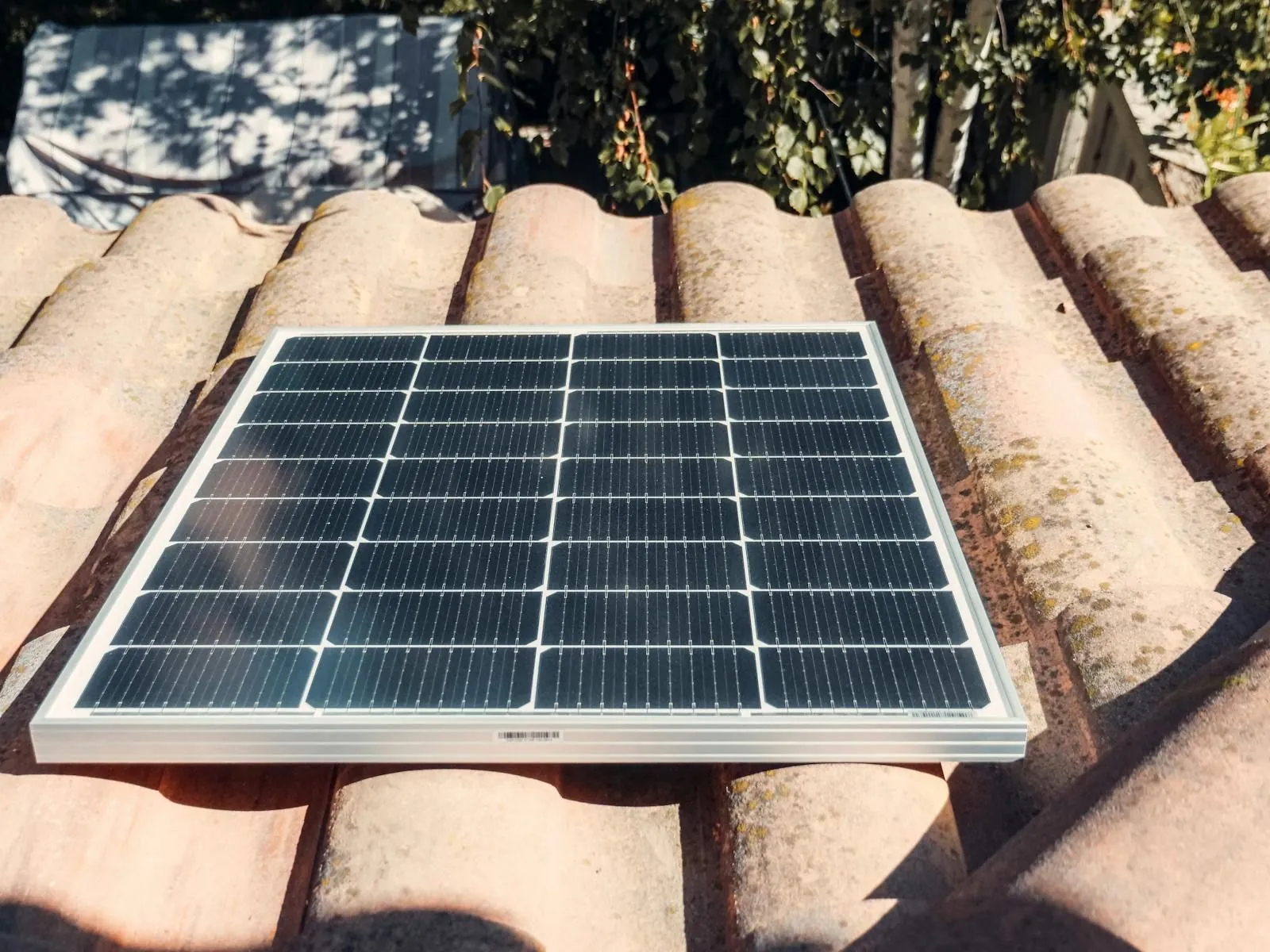
What the 120% rule actually is
The “120% rule” in commercial solar refers to the DC-to-AC ratio in system design. It means oversizing the DC array capacity (panel nameplate) by up to 120% of the inverter AC capacity. So a 100 kW inverter would be paired with up to 120 kWp of panels.
The reasoning is straightforward: solar panels rarely produce their full nameplate power. Standard Test Conditions (STC) — 1000 W/sqm irradiance, 25°C cell temperature, AM1.5 spectrum — are achieved in real-world UK installations for only a few hours per year. Most operating time, panels produce 60-85% of nameplate output.
Oversizing the DC array means more of the inverter’s AC capacity is used during normal operating conditions, improving annual yield. The trade-off: during peak irradiance (occasional bright summer noons), the inverter “clips” — limits output to AC nameplate — and some potential energy is lost.
Why 120% and not higher?
For UK installations, the optimal DC-to-AC ratio typically lands between 110% and 130% depending on:
- Latitude and irradiance. Southern England (40+°N) supports higher DC-to-AC ratios than Scotland (55+°N) because peak irradiance is rarer.
- Panel orientation. South-facing arrays peak harder than east-west arrays. East-west arrays support higher DC-to-AC ratios (often 125-135%) because their generation profile is flatter through the day.
- Inverter efficiency curve. Modern string inverters (Solis, Huawei, Sungrow) maintain >98% efficiency from 25% to 100% of nameplate — meaning DC oversizing improves average operating efficiency.
- Clipping loss tolerance. Most modern designs accept 1-3% annual clipping loss as the price of higher yield through the rest of the year.
The “120%” figure is a rule of thumb landing in the middle of this band — neither aggressive nor conservative. Most well-designed UK commercial systems sit at 115-125% DC-to-AC ratio.
The PVSyst model
Proper system design uses PVSyst (or equivalent) to model the specific DC-to-AC ratio that maximises 25-year NPV. The model accounts for:
- Latitude, longitude, altitude
- Hour-by-hour historical irradiance (PVGIS European Commission data)
- Panel orientation, tilt, azimuth
- Shading from adjacent buildings, vents, parapets, chimneys
- Inverter efficiency curve at each operating point
- Cabling losses
- Temperature derating
- Panel degradation over 25 years
We run PVSyst on every commercial proposal. The DC-to-AC ratio that maximises NPV typically lands between 112% and 128% for UK office installations.
What this means for office solar procurement
If you’re reviewing commercial solar quotes, two checks help validate the proposal:
- What DC-to-AC ratio is being designed? A quote showing 100% (DC = AC) is leaving 5-10% of annual yield on the table. A quote at 140%+ is accepting unnecessary clipping loss. The sweet spot is 115-125%.
- What annual yield is being modelled? UK rooftop solar at optimal orientation should deliver 900-1,050 kWh per kWp per year. East-west arrays land 820-950 kWh/kWp. If the proposal shows materially less, the system design isn’t capturing available yield.
Every proposal we deliver includes the PVSyst yield model and explicit DC-to-AC ratio in the technical specification. We’re happy to talk through the underlying assumptions on any specific project.
Request a feasibility study with full PVSyst yield modelling.
G98 vs G99: where the 120% rule intersects with grid connection
The 120% DC-to-AC ratio is an internal system design parameter, but it interacts directly with the UK grid connection regulatory framework — specifically the G98 and G99 Engineering Recommendations that govern how solar systems connect to the low-voltage and high-voltage distribution network.
G98 applies to single-phase and three-phase systems with an inverter AC output up to 16 A per phase (approximately 3.68 kW single-phase, 11 kW three-phase). G98 systems can connect under a simplified notification process: the installer notifies the Distribution Network Operator (DNO) within 28 days of commissioning. No prior approval is needed.
G99 applies to all systems above the G98 threshold — which in practice means every commercial office solar installation. Under G99, the installer must apply to the DNO before connection, the DNO has up to 45 working days (9 weeks) to respond, and the connection may require additional network studies, protection relays, or export limiting devices.
The DC-to-AC ratio matters here because G99 export limits are defined in AC kW, not DC kWp. A system designed at 120% DC-to-AC ratio with a 500 kW AC inverter exports at maximum 500 kW. The DNO is concerned with the AC export figure, not the installed panel capacity. Designers can therefore oversize the DC array (improving annual yield) without increasing the G99 AC connection size — a key reason the 120% approach is favoured on commercial systems in constrained network areas.
The G99 DNO application: what actually happens
Understanding the G99 process helps project managers plan realistic timelines and avoid the single most common source of programme delay.
Step 1: Pre-application enquiry. Before submitting a formal G99 application, many designers submit an informal pre-application enquiry asking the DNO to confirm the connection point, indicate network capacity, and flag any constraints. UKPN, ENWL, NGED, and SPEN all offer this service. Pre-application responses typically arrive in 2-4 weeks and can save months by identifying constraints early.
Step 2: Formal G99 application submission. The application requires system specification (kWp DC, kW AC, inverter type, protection relay specification), single-line diagram, site address and metering details. The DNO has 45 working days to respond, but complex or constrained connections regularly take 3-6 months.
Step 3: Network study (if required). For systems above 50 kW AC in constrained network areas, the DNO may require a technical network study to assess the impact of the new generator. These studies are charged to the applicant (typically 1,000-8,000) and add 4-12 weeks to the programme.
Step 4: Offer to connect. The DNO issues an offer specifying the approved AC export limit, any required protection settings, and the connection charge. The applicant has 30 working days to accept.
Step 5: Commissioning and witnessing. After installation, the DNO typically requires a commissioning visit to witness the protection relay settings and confirm the system is operating to the approved specification. This visit is usually 1-2 weeks after install completion.
For most UK office solar projects, G99 is the longest lead-time item in the programme. Filing the G99 application immediately after contract award — running it in parallel with design, planning, and procurement — is the most important single schedule management action.
How the 120% rule applies to three-phase systems
The overwhelming majority of commercial office solar installations connect to three-phase supplies. Understanding how DC-to-AC ratio applies in three-phase context requires understanding inverter sizing in three-phase terms.
A 100 kW three-phase string inverter rated at 100 kW AC output can accept up to 120 kWp DC array under the 120% rule. Each of the three phases sees approximately 33 kW AC — well within G99 threshold for per-phase export.
Where buildings have unbalanced three-phase loads (common in older office buildings with poorly distributed single-phase loads), the inverter’s three-phase output should be designed to match the building’s three-phase metering configuration. This affects how self-consumption is measured — import/export monitoring at the main incomer needs to be three-phase aggregate to reflect actual building economics correctly.
For buildings with single-phase supplies (rare above 100 kWp but possible in small conversions), the 120% rule still applies but clipping risk is higher because single-phase load profiles are more variable. Most small-office single-phase systems land at 110-115% DC-to-AC ratio rather than 120% to limit clipping.
Workarounds when 120% doesn’t fit
Three scenarios where the standard 120% approach needs modification — and the engineering solutions.
Constrained G99 export limit. Where the DNO approves an AC export limit below inverter nameplate (say, 80 kW export limit on a 100 kW inverter), the system design adjusts the export limiting set-point. The DC-to-AC ratio remains at 120% (maximising self-consumption yield), but the inverter export is capped by an export-limiting relay. Self-consumed generation is unaffected by the export limit — only grid export is curtailed.
Battery storage integration. Where battery storage is included, the DC-to-AC ratio calculation changes because the battery can absorb generation that would otherwise be clipped. With a 200 kWh battery, the effective DC-to-AC ratio can be pushed to 130-135% without meaningful energy loss — the battery charges during peak generation and discharges during demand peaks. This is a significant benefit of battery systems beyond their load-shifting economics.
Load management (demand-side response). In sophisticated building management systems (BMS), high-consumption equipment (HVAC, server cooling, EV chargers) can be dispatched to absorb generation peaks. Effective BMS load management reduces clipping at high DC-to-AC ratios and effectively increases optimal DC array size. Advanced office buildings with sophisticated BMS can support 125-135% DC-to-AC ratios without meaningful clipping loss.
Which DNOs are most flexible on G99
DNO responsiveness and flexibility on G99 applications varies significantly across UK network areas.
Most flexible (fastest typical response times, lowest network study rate):
- NGED (South West and Midlands) — typically 6-8 weeks to G99 offer, network studies required on fewer than 20% of commercial applications
- SPEN (Scotland) — typically 8-10 weeks, straightforward process with pre-application support
Moderate:
- YEDL/NPG (Yorkshire/North) — typically 8-12 weeks
- WPD/NGED (East Midlands) — typically 8-12 weeks
Most challenging (constrained networks, longest response times):
- UKPN (London and South East) — 12-20+ weeks for complex connections, network studies common in inner London
- ENWL (Greater Manchester, Lancashire) — 10-16 weeks, constrained in some urban areas
The DNO constraint picture changes over time as network investment programmes resolve congestion. Pre-application enquiry is the best tool for understanding current constraint position at a specific site.
Real-world application example
A 480 kWp office system in Solihull (NGED network area) illustrates the 120% rule in practice.
Design parameters: 1,200 x 400W bifacial panels (480 kWp DC). Three Sungrow SG160CX inverters at 160 kW AC each (480 kW total AC). DC-to-AC ratio: 100%.
PVSyst model result at 100% DC-to-AC: Annual yield 441,600 kWh. Clipping loss: 0.3%.
Redesigned at 120% DC-to-AC: 1,440 x 400W panels (576 kWp DC). Same three 160 kW inverters (480 kW AC). Clipping loss: 2.1%.
PVSyst result at 120% DC-to-AC: Annual yield 469,200 kWh — a 6.2% increase for a 20% increase in panel count, at roughly 60% of the marginal cost per kWh improvement. The additional 96 kWp of panels costs approximately 14,000 and delivers an additional 27,600 kWh/year — worth approximately 8,000/year at current avoided-cost rates. Payback on the marginal panel investment: 1.75 years.
This is why the 120% rule exists: it is a straightforward way to capture low-cost annual yield improvement.
Key takeaways
- The 120% rule refers to oversizing DC panel capacity to 120% of inverter AC nameplate, improving annual yield by capturing more generation during normal (below-peak) irradiance conditions
- G99 is required for all commercial solar installations; the AC capacity (not DC) determines G99 export limits — so DC oversizing does not increase G99 connection size
- Three-phase systems apply the same ratio, with care needed on phase balancing for older buildings with unbalanced loads
- Battery storage enables higher DC-to-AC ratios (130-135%) by absorbing generation that would otherwise clip
- DNO response times vary significantly: NGED is typically fastest (6-8 weeks), UKPN slowest (12-20+ weeks) in constrained areas
- Pre-application DNO enquiry is the single most important schedule management tool for commercial solar projects