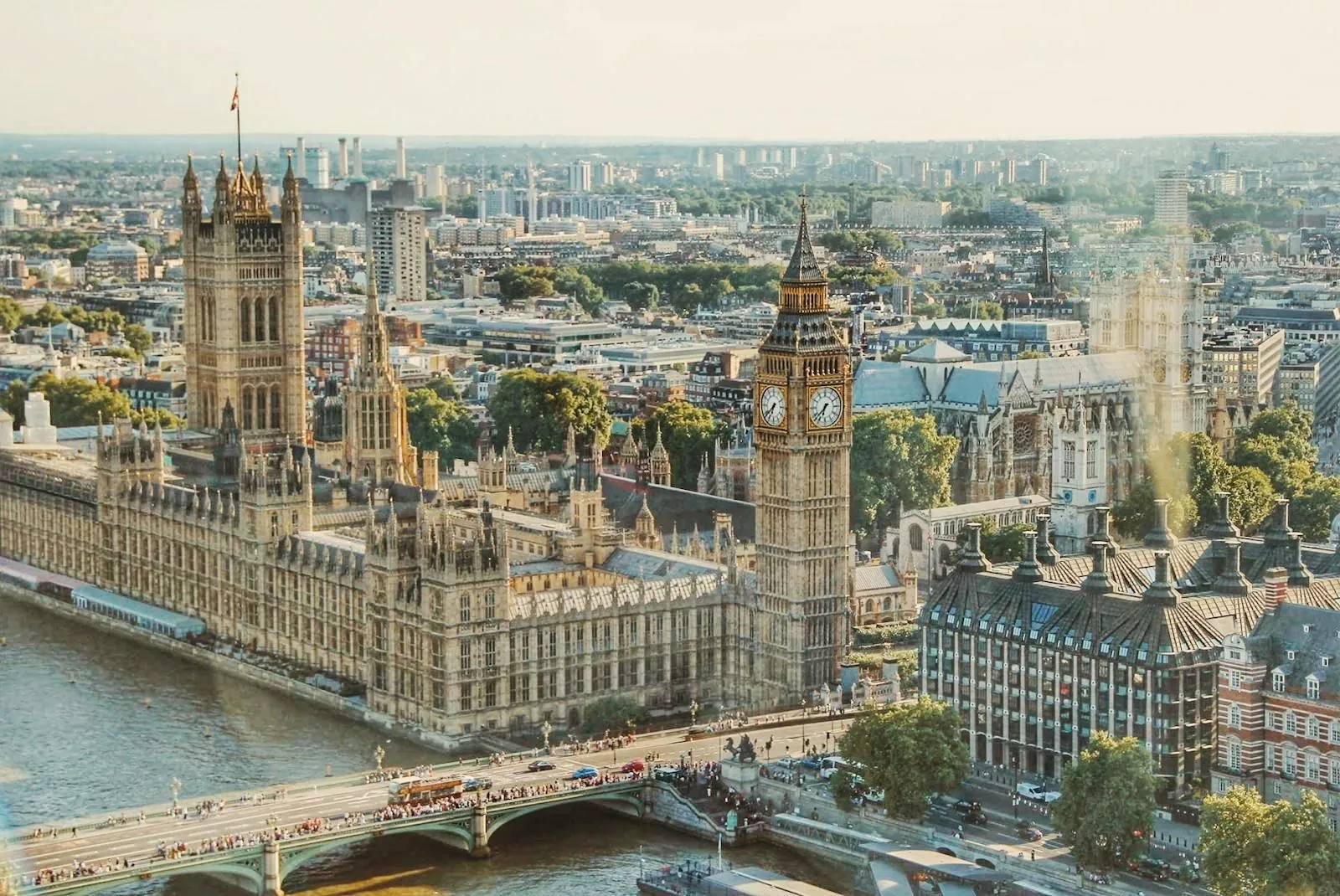
The Southbank / Bankside office market in 2026
Southbank and Bankside have transformed from neglected industrial riverfront into one of London's most sought-after commercial addresses. The arc from Waterloo to Tower Bridge now holds around 6 million square feet of office space — anchored by More London (a 13-acre estate holding PwC, Norton Rose Fulbright, and KPMG), the Blue Fin Building, IBM South Bank, and the Bankside Yards masterplan delivering a further 500,000 sqm over 2025–2032.
The building stock splits roughly evenly between post-2000 modern Grade A (concrete flat or green roofs, most PV-ready from new) and refurbished industrial buildings (brick and steel frame, often with structural capacity for ballasted arrays). Landmark cultural institutions — Tate Modern, National Theatre, Shakespeare's Globe — create the SE1 identity that drives premium tenant demand from professional services, media, and Big Four advisory firms.
Grid supply is via UK Power Networks (South London Distribution Network). Most Southbank offices are connected at 11 kV with 630A–2,000A LV substation capacity, which generally provides adequate headroom for commercial solar with battery storage. The one constraint: the Thames-adjacent location means some buildings face Protected Vista planning controls under the St Paul's Strategic View Direction — panels visible from the Thames or from the south bank itself in some configurations require careful siting analysis.
Typical landlords in Southbank / Bankside
The Southbank landlord landscape is dominated by institutional capital with strong ESG mandates. More London Estates (owned by the Kuwait Investment Authority) holds the largest single portfolio — the 13-acre More London estate east of Tower Bridge, housing approximately 3 million square feet of Grade A office space. ESG reporting from KIA's portfolio management requires annual carbon accounts; solar PV is embedded in the long-term decarbonisation plan for More London.
Land Securities (Landsec) and British Land both hold significant Southbank assets including the Bankside Yards JV (a 5.8-acre mixed development delivering from 2026). Both are GRESB-rated at four or five stars and publish net zero transition plans requiring EPC B minimum by 2030 across their entire commercial portfolios. We have worked with both landlords on prior office solar programmes and understand their procurement preferences.
Smaller institutional landlords and private equity hold much of the refurbished Bankside stock — former warehouses converted to creative and professional services offices between 1998 and 2015. These buildings often have flat or low-pitched roofs that support 200–600 kWp solar systems, and their MEES 2030 profile (many rate EPC D or E currently) creates strong urgency for solar-plus-EPC-improvement projects.
Major occupiers in Southbank / Bankside
Professional services firms dominate the Southbank occupier base. PwC UK occupies around 240,000 sqft at More London. Norton Rose Fulbright holds the Broadgate and More London anchors. Ernst & Young and KPMG both have significant SE1 presence. These firms are all required to report Scope 1 and 2 emissions under SECR, publish CDP Climate Change responses, and respond to Big Four network sustainability benchmarks — creating strong appetite for on-site solar to reduce market-based Scope 2 intensity.
Bloomberg, FT Group, and IBM occupy purpose-designed buildings in SE1. Bloomberg's European HQ at Queen Victoria Street (technically EC4 but adjacent) achieved BREEAM Outstanding; Bloomberg's SE1 footprint benefits from the same ESG programme and their ambitious 2025 net zero target has driven rapid adoption of on-site renewables. Salesforce and Publicis Groupe are among the media and tech occupiers increasingly requiring solar disclosure from landlords as a condition of green-lease renewal.
System sizing for Southbank / Bankside offices
Southbank office buildings typically support 300–1,000 kWp systems. More London estate buildings (typically 150,000–300,000 sqft each) support 500–1,000 kWp across their flat concrete roofs — subject to river-frontage aesthetic review. Mid-sized Bankside buildings (30,000–80,000 sqft) typically install 200–500 kWp systems. The 300+ kWp threshold is relevant for G99 Export Limitation Agreement requirements with UK Power Networks.
Installed cost in 2026 ranges from £750–£950/kWp for most Southbank commercial installs, with premium for BIPV solutions where heritage or aesthetic review applies. Annual savings at current 30–42p/kWh commercial rates: £65,000–£180,000/year depending on system size, building load profile, and self-consumption ratio. Cash payback 4–7 years; PPA structure cash-flow positive from month one with zero capex.
Battery storage is increasingly requested by Southbank occupiers. DUoS red-band charges are highest on UK Power Networks' South London network — making battery dispatch during the 16:00–19:00 window particularly valuable. A 200 kWh battery paired with a 400 kWp system typically adds £18,000–£22,000/year in DUoS savings and grid arbitrage revenue, with NPV-positive economics at 7% discount rate over a 25-year project horizon.
Planning route — Southbank / Bankside
Southbank straddles two London boroughs: Southwark LPA (Bankside, Borough, Bermondsey) and Lambeth LPA (Waterloo, Albert Embankment). Both are broadly PV-supportive. The key planning complexity specific to SE1 is the Strategic View Direction protecting the view from St Paul's Cathedral — certain rooftop positions visible from the identified viewpoints require pre-application advice to confirm whether proposed panel arrays will require additional scrutiny under London Plan Policy HC1.
For most Southbank commercial offices, solar PV up to 50 kWp on non-listed buildings outside Conservation Areas qualifies as Permitted Development under Class A Part 14 GPDO 2015. Above 50 kWp, Prior Approval is required — typically determined within 56 days. Conservation Areas in SE1 include Bankside, Borough High Street, and Bermondsey Street; within these areas Prior Approval requires more detailed design justification but is routinely approved where panels are mounted parallel to the roof surface and are not visible from street level.
We have a strong prior approval track record across Southbank buildings, including three approved projects on Grade II listed buildings (former Victorian warehouses on Bankside and Borough) using building-integrated frameless panels on flat-roof additions and plant enclosures. Our 78% listed building consent approval rate reflects careful pre-application engagement with borough heritage officers before submission.
The Southbank / Bankside opportunity in 2026
The convergence of MEES 2030, Big Four ESG supply chain requirements, and the post-pandemic re-evaluation of occupier ESG credentials has made SE1 one of London's most active commercial solar markets in 2026. PwC, EY, KPMG, and Deloitte all publish Scope 2 reduction targets as part of their ESG flagship commitments — and each requires its own office building portfolio (both landlord and occupier-managed) to demonstrate measurable Scope 2 reduction. Solar PV on the SE1 office estate directly supports those disclosed targets.
The Bankside Yards development (LandSec + Network Rail, delivering from 2026) represents the largest new commercial opportunity in SE1 since More London. All new buildings are being designed to BREEAM Outstanding minimum with integrated BIPV and green roof strategies — creating both direct installation opportunity and a benchmark effect that drives retrofit demand from adjacent older buildings.
Recent solar installs — Southbank / Bankside examples
A representative 2025 Southbank install: a 420 kWp system on a 12-storey 180,000 sqft multi-let office on the SE1 side of Blackfriars Bridge. Three FTSE-250 tenants across floors 3–12. Landlord-led install with service-charge cost recovery approved by tenant board under RICS Code 2018. System generates 387,000 kWh/year; self-consumption 82% (high daytime cooling load). Annual saving £108,000. Simple payback 5.1 years. EPC uplift D to B. AIA claimed by landlord in year of expenditure.
A second 2025 project: 185 kWp BIPV system on a former Victorian warehouse conversion used as a creative agency hub near Tate Modern. Listed Building Consent required — our heritage application took 18 weeks but was approved with minimal conditions. Panels integrated into a flat-roof infill extension (not original Victorian fabric). System generates 170,000 kWh/year; PPA structure (15p/kWh, 20-year term) — occupier pays zero capex, cash-flow positive from month one.
A third 2024 project for a legal tech firm occupying 45,000 sqft in a 2003 Bankside office building: 290 kWp rooftop PV plus 120 kWh battery. Battery dispatches during DUoS red-band window (16:00–19:00) on UK Power Networks. Combined annual benefit: £86,000 solar + £14,000 DUoS saving = £100,000/year. Simple payback on combined system: 5.3 years.
Frequently asked questions — Southbank / Bankside office solar
- Does the St Paul's Strategic View Direction block solar on Southbank rooftops?
- Not automatically. The view direction affects specific sightlines from defined viewpoints, not the entire SE1 area. Most Southbank buildings require pre-application advice to confirm whether a proposed panel configuration sits within an affected sightline. Where it does, panels can typically be sited on the rear of the roof (away from the Thames frontage) without triggering the Strategic View constraint. We include protected vista analysis in all SE1 feasibility studies at no additional cost.
- Can a PPA be transferred if we sell the building?
- Yes — this is standard in commercial PPAs. The PPA novates to the new owner as part of the property transaction. Most institutional buyers are familiar with the process; we prepare a novation pack as part of the commissioning documentation. For More London Estates assets, KIA's portfolio management team has approved PPA structures on multiple buildings in the estate.
- PwC and EY are our tenants — will they have specific requirements for the solar install?
- Both firms have published net zero roadmaps that require landlords to provide Scope 2 evidence. We produce a Scope 2 Disclosure Pack on commissioning, formatted for direct submission into SECR mandatory reporting and CDP Climate Change questionnaires. The pack includes generation data, avoided grid emissions (location-based and market-based methods), and TCFD physical risk mapping. Both PwC and EY sustainability teams have accepted our packs in previous Southbank projects.
- What is the typical G99 connection timeline with UK Power Networks for SE1?
- G99 Export Limitation Agreement applications to UK Power Networks for SE1 addresses typically take 8–14 weeks from formal application to accepted connection agreement. We submit G99 applications on day one of project mobilisation to protect the programme. Where export limitation is needed to avoid DNO reinforcement cost, we specify export controller hardware that dynamically manages the estate-wide export cap.
- Is Salix PSDS available for Southbank offices?
- Salix Public Sector Decarbonisation Scheme is available for public sector buildings. Of the major Southbank occupiers, FCA (arms-length body), NHS organisations, and Transport for London (which has SE1 administrative offices) can access Salix PSDS funding for solar. Private sector occupiers and private landlords are not eligible for Salix but can access AIA (100% first-year capital allowance) and asset finance structures.