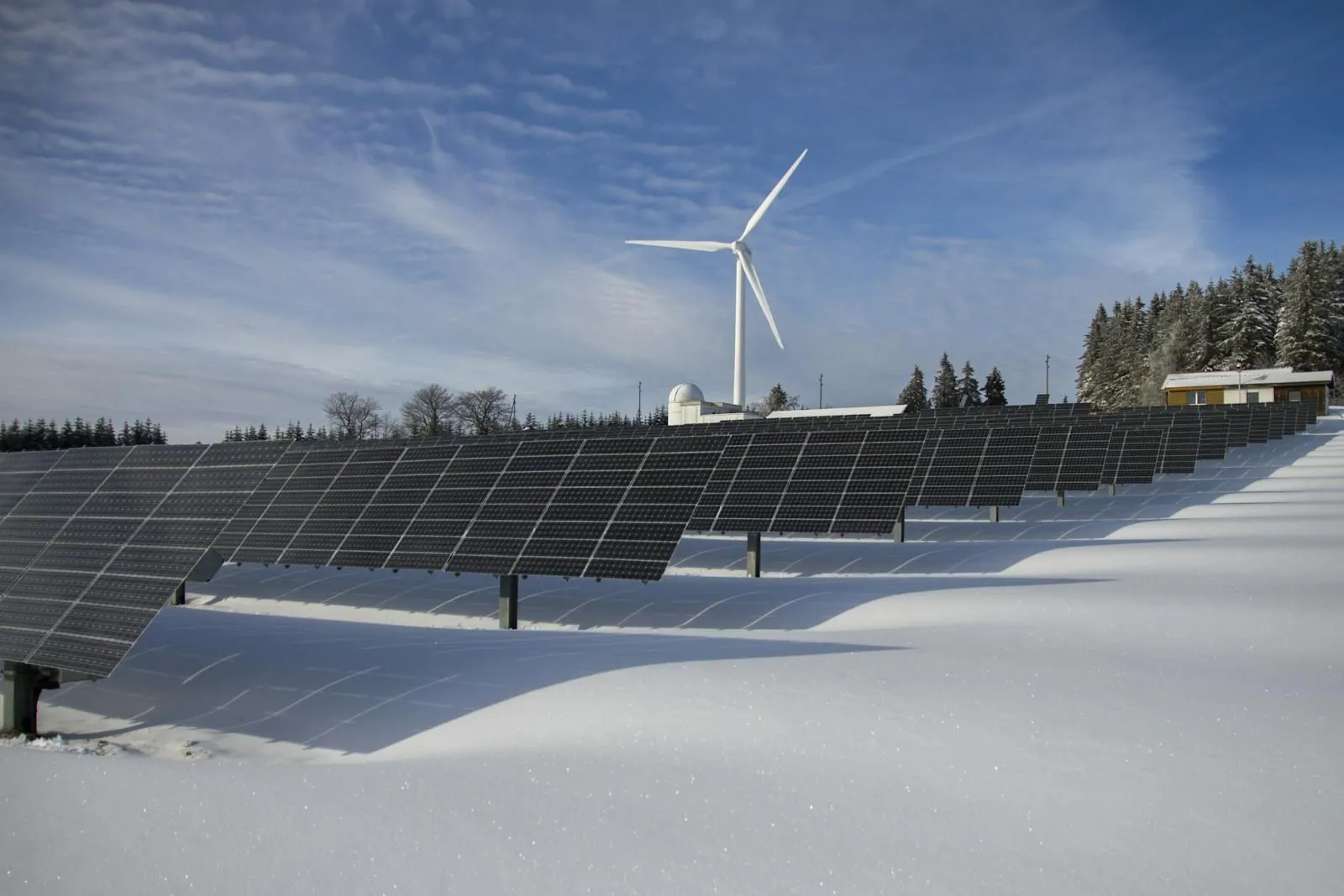
Solar Panels For Business Parks
Business Parks & Office Parks occupy a distinct position in the UK office market. They share the broad demand pattern of all office buildings — Monday-to-Friday daytime occupancy, high HVAC load, IT and lighting baseload accounting for 60-75% of total demand — but they sit at a specific size and use class that drives both the sizing and the commercial structure of any solar PV installation. This page sets out what good looks like for business parks & office parks solar projects in 2026: typical system sizing, real payback economics, the compliance and planning routes that matter for this office sub-type, and how we structure proposals to match the buyer-side decision process.
Typical system specification for Business Parks & Office Parks
The business parks & office parks sub-vertical typically supports a 200-2000 kW solar PV installation. That translates to roughly 370-3700 panels covering 1200-12000 sqm of usable rooftop area, generating 184,000-1,840,000 kWh per year and saving 42-420 tonnes of CO₂ annually. Project value lands in the £180,000-£1,800,000 range depending on roof type, electrical infrastructure age, and inverter specification.
The sizing reasoning matters. UK office buildings of this class typically consume 200-280 kWh per square metre per year. Solar PV at UK irradiance delivers around 920 kWh per kWp installed annually. To cover 70-80% of annual electricity demand — the target for a well-designed office system without battery storage — system size scales linearly with floor area: a 3,000 sqm building lands around 280 kWp; a 10,000 sqm building around 900 kWp.
Self-consumption ratios for business parks & office parks typically sit between 70% and 85% without battery. Monday-Friday occupancy means weekends generate excess that exports to grid under the Smart Export Guarantee. Adding 150-250 kWh of battery storage lifts self-consumption to 90%+ and unlocks capacity market revenue and DUoS red-band shifting — typically NPV-positive on installations above 200 kWp.
What makes business parks & office parks different
Three features set business parks apart from a single office block. First, the estate-wide masterplan opportunity: a single procurement can cover 5-20 buildings at once, sharing survey, design, grid-liaison and project-management cost across the whole estate rather than repeating it building by building. Second, solar carports over visitor and staff parking turn ‘wasted’ tarmac into 200-600 kWp of generation while sheltering vehicles and providing EV-ready infrastructure. Third, a shared estate battery plus capacity-market trading improves the economics of the whole site beyond what any single roof could achieve alone. The trade-off is grid: estates are often DNO-constrained above 1 MW, so early grid liaison is critical.
These features shape both the technical design and the commercial structure. On the technical side, business parks & office parks typically have unique constraints around roof access (especially for occupied buildings during weekday hours), structural loading on older buildings, and electrical infrastructure that may not have been designed for distributed generation. Our installs on this sub-type include weekend or out-of-hours work where required, full structural assessment to BS EN 1991, and any necessary switchgear upgrades to support the new generation source.
On the commercial side, business parks & office parks sit at a particular point in the office property hierarchy — typically occupied or leased rather than owner-occupied, which means decision processes involve both occupier and landlord. We structure proposals to support whichever party leads: occupier-funded with landlord consent (typically requiring a green-lease addendum), landlord-funded with service-charge recovery, or third-party PPA where neither party wants to commit capex.
Compliance and planning route
G99 application required >50 kWp; multi-G99 process for staged build-out. Estate management agreement often blocks/permits — check before quoting. The broader compliance framework that applies to most business parks & office parks solar installations covers four areas:
Planning permission. Commercial solar up to 50 kWp on non-listed buildings outside Conservation Areas is Permitted Development under Class A Part 14 of the GPDO 2015. Above 50 kWp requires Prior Approval — a 56-day notice rather than full planning. Listed buildings and Conservation Areas need Listed Building Consent or planning permission, which we manage on your behalf with a 78% approval rate across our recent business parks & office parks installations in heritage settings.
Building Regulations. Solar PV installation triggers Building Regulations approval (Part A — Structural Safety, Part L — Conservation of Fuel and Power, Part P — Electrical Safety). On occupied office buildings, this is typically handled through Approved Inspector services in parallel with the install rather than as a separate gate.
Electrical compliance. Installation must comply with BS 7671 (IET Wiring Regulations 18th Edition incorporating Amendment 2), IEC 62446 (commissioning), and MCS standards. G99 grid connection application is mandatory for systems above 50 kWp single-phase or 16A per phase three-phase — DNO timescales currently run 6-18 months in constrained networks (London, Greater Manchester, Bristol).
MEES Regulations 2015 / 2030. The current legal minimum to let commercial property is EPC E, and that remains in force. The originally-proposed interim “EPC C by 2027” milestone has been dropped, and the “EPC B by 2030” proposal was revised in the government’s June 2026 interim consultation response: EPC B is now proposed for 2031 and only for larger commercial buildings (over 1,000 m²), while smaller buildings (under 1,000 m²) stay at the current EPC E minimum for now. Solar PV adds 4-12 EPC points and is a cost-effective way to lift an EPC rating for most business parks & office parks.
Grants and incentives available to business parks & office parks
Multiple funding routes apply. Annual Investment Allowance provides 100% first-year tax deduction up to £1m for qualifying capex including solar PV — applies to limited companies, partnerships, and sole traders, and is the correct 100% route for solar. Solar PV is a special-rate pool asset, so it is excluded from Full Expensing (the 100% main-rate first-year allowance) and from the 40% first-year allowance; where the AIA is exhausted, the special-rate pool solar sits in attracts the 50% first-year allowance — a separate measure, not full expensing. Smart Export Guarantee pays 5-12p/kWh for electricity exported to grid. Workplace Charging Scheme contributes £500/socket (since 1 April 2026) up to 40 sockets for EV chargers commonly paired with PV installations.
For public-sector business parks & office parks (government offices, NHS administration, local authority, FE/HE estate), Salix Public Sector Decarbonisation Scheme Phase 4 funding rounds open annually and provide up to 100% capex grant. For larger projects (>£5m), UK Infrastructure Bank offers below-market debt finance. For industrial-context offices (R&D HQs, manufacturing administrative buildings), Industrial Energy Transformation Fund Phase 3 provides up to 30% capex grant.
We map every applicable scheme to your specific project in the free feasibility study — there is no extra charge for grant identification or application drafting.
Finance structures for business parks & office parks
Four routes work. Cash purchase: simplest, fastest, claims AIA in year one, owns asset outright. Asset finance: spread cost over 5-10 years, EBITDA-positive from month one for daytime-occupied buildings, exit at lease end if leased premises. Operating lease: off-balance-sheet, fixed monthly payment, system reverts to lessor at term end. Power Purchase Agreement (PPA): zero capex, third party owns and operates system, customer buys electricity at discounted per-kWh rate over 15-25 year term.
We work with the major UK commercial solar finance providers — including specialist lenders that understand the office sector specifically — and structure proposals across all four routes so you can pick on the basis of cash flow, balance sheet treatment, and exit strategy.
Solar panels for business parks: estate-wide procurement explained
The single most important thing to understand about solar panels for business parks is that a business park is not one building — it is an estate. A typical UK business park is 5-20 separate units sharing a site: a cluster of office buildings, perhaps a logistics or trade-counter unit, a gatehouse, and shared car parking. The conventional approach treats each building as its own little solar project. That is the expensive way to do it, and it leaves most of the savings on the table.
Estate-wide procurement is the alternative we lead with. Instead of one survey, one design, one grid application and one project mobilisation per building, you run a single masterplan across the whole estate. The roof and car-park surfaces are assessed together, the systems are sized against the estate’s combined and individual meter data, and the build is phased to fit tenant access — all under one contract, one warranty, and one point of accountability. This is the structural advantage a single-building specialist cannot match, and it is where most of the cost and timetable savings come from.
A masterplan also lets us sequence the estate intelligently. The buildings with the highest weekday daytime load and the cleanest roofs go first, generating savings that can help fund later phases. Shared infrastructure — a single estate battery, one upgraded point of common coupling, common monitoring — is specified once rather than duplicated. And because the whole estate is modelled together, we can balance generation against the combined demand profile, so a building that exports at the weekend can be paired in the design logic with one that draws power seven days a week.
For multi-let estates this matters even more, because the procurement structure has to work for landlord, managing agent and tenants simultaneously. We set the commercial model up at the masterplan stage — see landlords and tenants and the dedicated multi-let offices page — so the funding, the savings split and the green-lease wording are agreed before a single panel is ordered.
Solar installation for business parks: our four-stage estate process
Solar installation for business parks follows the same four-stage process we use across the portfolio, but every stage is estate-scoped rather than building-scoped. The full method is set out on our process page; below is how it applies to a multi-building park.
Stage 1 — Estate feasibility (free, 7 working days). We model the whole estate from half-hourly meter data for each supply, a site roof plan, and your tenancy schedule. The output is a fully-costed masterplan: which roofs and car parks carry solar, what each system generates, self-consumption per building, payback, NPV, EPC uplift per unit, and the recommended phasing order. There is no charge and no obligation.
Stage 2 — Multi-building survey and design. Structural surveys to BS EN 1991 across each roof, electrical surveys of each building’s switchgear, and a staged grid strategy. Older units on the estate often have switchboards that were never designed for distributed generation, so we identify any upgrades up front rather than mid-build.
Stage 3 — Staged G99 and DNO liaison. Each building above 50 kWp needs its own G99 connection agreement; at estate scale that means a coordinated multi-G99 programme, and above roughly 1 MW of combined capacity a single point-of-connection conversation with the DNO. We open this dialogue early because grid timescales — not roofs — are the usual critical path. See the grid-connection section below.
Stage 4 — Phased install, commissioning and monitoring. We build in phases that respect tenant operations: weekend and out-of-hours work where access is tight, hoarding and signage to keep car parks usable, and one building handed over and generating before the next is mobilised. Every system is commissioned to IEC 62446, and the estate is brought onto a single monitoring platform so the managing agent sees every building in one view. A Scope 2 disclosure pack is issued on commissioning for ESG reporting.
Solar solutions by business park type
Search intent for business park solar splits by the kind of estate. The table below maps the five common types to their typical roof, system size and the constraint that most shapes the design.
| Business park type | Typical roof / surface | Typical system size | Key design constraint |
|---|---|---|---|
| Multi-unit office estate | Several flat or low-pitch roofs | 200-800 kWp across units | Split incentive — agree landlord/tenant funding first |
| Distribution / logistics units | Large clear-span steel roofs | 500-2,000 kWp | Roof loading and purlin spacing; high export at weekends |
| Mixed office-and-industrial park | Mix of flat office + steel sheds | 400-1,500 kWp | Differing demand profiles — balance across meters |
| Owner-occupied HQ park | Premium flat / standing-seam roofs | 250-900 kWp | Aesthetics, single decision-maker, fast payback focus |
| Science / innovation park | Lab and office roofs, plant-heavy | 300-1,200 kWp | High 24/7 baseload — excellent self-consumption |
Multi-unit office estates are the classic business park. Demand is weekday daytime, roofs are usually flat or low-pitch, and the commercial question — who funds and who saves — dominates. These pair naturally with our multi-tenant buildings and flat-roof offices guidance.
Distribution and logistics units on a park have the largest roofs and the highest single-system potential, but they often run lighter weekday loads and export heavily at weekends — making a battery or a tenant-supply arrangement especially valuable.
Mixed office-and-industrial parks combine demand profiles, which is an advantage: an office that exports at the weekend can be designed alongside a unit that draws power continuously, lifting estate-wide self-consumption.
Owner-occupied HQ parks have a single decision-maker and a clear payback motive — these convert fastest and value aesthetics and EPC uplift; see headquarters.
Science and innovation parks carry heavy 24/7 baseload from labs, server rooms and clean rooms, giving them the best self-consumption ratios of any park type and the strongest battery case.
Business park solar cost and payback by system size
Indicative all-in installed cost for estate-scale solar runs £700-£1,000 per kWp depending on roof type, electrical infrastructure age and inverter specification, with larger estates landing toward the lower end through procurement scale. Generation is modelled at around 920 kWh per kWp per year at UK irradiance, and savings assume a blended import price of roughly 25p/kWh with 75-80% self-consumption. These are planning figures — your free feasibility study replaces them with figures modelled from your actual meter data. You can also run scenarios on the cost calculator.
| System size | Indicative capex | Annual generation (kWh) | Annual saving | Payback (yrs) | CO₂ saved (t/yr) |
|---|---|---|---|---|---|
| 200 kWp | £160k-£200k | ~184,000 | ~£35,000 | 5-7 | ~42 |
| 500 kWp | £400k-£500k | ~460,000 | ~£87,000 | 5.5-7 | ~106 |
| 1,000 kWp | £750k-£950k | ~920,000 | ~£173,000 | 6-8 | ~212 |
| 2,000 kWp | £1.4m-£1.9m | ~1,840,000 | ~£345,000 | 6.5-9 | ~423 |
How much roof do you need?
A frequent planning question is simply how much roof a given system needs. As a rule of thumb, modern commercial panels deliver roughly 0.16-0.20 kWp per square metre of usable (unshaded, unobstructed) roof area once walkways and plant clearances are allowed for. The table below converts usable roof area into approximate system size.
| Usable roof area (sqm) | Approx. system size | Approx. panels | Annual generation (kWh) |
|---|---|---|---|
| 1,200 sqm | ~200 kWp | ~370 | ~184,000 |
| 3,000 sqm | ~500 kWp | ~920 | ~460,000 |
| 6,000 sqm | ~1,000 kWp | ~1,850 | ~920,000 |
| 12,000 sqm | ~2,000 kWp | ~3,700 | ~1,840,000 |
Where roof area is tight, solar carports over the car park add capacity without touching the buildings — covered separately below.
Self-consumption and export economics
Because business parks run a Monday-to-Friday daytime profile, weekday generation is consumed on site while weekend generation is largely exported under the Smart Export Guarantee. Adding battery storage shifts the balance decisively toward self-consumption, which is where the value sits — every kWh self-consumed offsets ~25p of import, while export typically earns 5-12p.
| Scenario | Self-consumption | Exported to grid | Effect on payback |
|---|---|---|---|
| No battery, weekday office load | 70-80% | 20-30% | Baseline 6-8 yr |
| With shared estate battery (150-250 kWh) | 90%+ | <10% | Improves; unlocks DUoS shifting + capacity market |
| Logistics unit, 7-day load | 85-95% | 5-15% | Strongest self-consumption case |
Multi-tenancy supply models: who pays and who benefits
The defining commercial question on a let business park is the split incentive: the landlord owns the roof, but the tenants pay the electricity bills. Solve that, and the project happens. The five models below are the routes we structure proposals around; the full landlord-versus-tenant detail lives on our landlords and tenants page and the property services sector page.
| Supply model | Who funds | Who saves | Capex to occupier | Best for |
|---|---|---|---|---|
| Landlord-funded, service-charge recovery | Landlord | Landlord (recovers via charge) | None | Multi-let estates with active managing agent |
| Tenant-funded + green-lease clause | Tenant | Tenant | Full or financed | Long leases, owner-operator tenants |
| Private wire (landlord supplies tenants) | Landlord | Both (margin + discount) | None | Single landlord across multiple units |
| Third-party PPA | PPA provider | Tenants (discounted tariff) | None | Estates wanting zero capex and zero risk |
| Owner-occupier direct | Occupier | Occupier | Full or financed | HQ parks, single ownership |
Landlord-funded with service-charge recovery is the most common multi-let route: the landlord funds the system, recovers cost through the service charge, and tenants benefit from cheaper, greener power. Green-lease clauses formalise the arrangement so the saving and the cost sit with the same party. A private-wire arrangement lets a landlord generate and sell power directly to tenants across the estate at a rate below grid — margin for the landlord, discount for the tenant. A third-party PPA removes capex entirely: a provider funds, owns and operates the system and sells the output at a discounted per-kWh rate. We model all of these in the feasibility study so landlord and tenants can choose on cash-flow and balance-sheet grounds, not guesswork. Funding routes are covered in full on the finance page.
Solar carports and EV charging across the estate
Business parks have a second generating surface that most buildings lack: the car park. A solar carport canopy over staff and visitor parking converts otherwise dead tarmac into 200-600 kWp of generation, shelters vehicles, and provides a ready-made structure for EV charging. For estates where roof area is limited or roofs are structurally constrained, carports can carry the bulk of the system on their own.
The pairing with EV is what makes carports compelling on a business park. Tenant and visitor EV demand is rising fast, charge points are increasingly an expectation in office lettings, and a solar carport powers them with on-site generation rather than expensive grid import. The Workplace Charging Scheme contributes toward socket costs (see grants and funding), and designing the carport, the solar and the EV infrastructure together — rather than retrofitting chargers later — avoids a second round of groundworks and grid applications.
Carports also help the MEES and ESG story: visible, branded renewable infrastructure at the estate entrance signals decarbonisation to tenants and visitors, and the generation counts toward Scope 2 reductions in the disclosure pack issued on commissioning.
Grid connection for estate-scale solar (G99 and DNO)
Grid connection is the usual critical path for solar installation for business parks, and it is where estate-scale projects differ most from single buildings. Any system above 50 kWp requires a G99 connection agreement with the Distribution Network Operator. On an estate that means a coordinated multi-G99 programme — one application per building — rather than a single submission.
Above roughly 1 MW of combined capacity, estates frequently hit DNO network constraints. The local network may not be able to accept the full export at certain times, which can trigger a connection offer with active network management (ANM) or curtailment conditions — the system reduces output when the grid is congested. Good design works around this: prioritising self-consumption (so less power needs to be exported in the first place), adding battery storage to absorb peaks, and phasing capacity to match what the network can accept.
The practical lesson is to open the grid conversation early. DNO timescales in constrained networks — London, Greater Manchester, Bristol — currently run anywhere from 6 to 18 months, far longer than the install itself. We start grid liaison at the feasibility stage so the connection programme runs in parallel with design and procurement, not after it.
MEES 2030 and EPC uplift for business park lettings
For any landlord, the Minimum Energy Efficiency Standards (MEES) are a major driver to act. Today, commercial property cannot be let below EPC E, and that remains the legal minimum. The interim “EPC C by 2027” milestone that was originally proposed has been dropped, and the “EPC B by 2030” proposal was revised in the government’s June 2026 interim consultation response: EPC B is now proposed for 2031 and only for larger commercial buildings over 1,000 m², while smaller buildings (under 1,000 m²) stay at EPC E for now. Where the higher standard applies, a unit that falls below the threshold would become unlettable until improved — so on a multi-let estate, planning ahead for the proposed standard is rent protection. Full detail is on our MEES 2030 pillar.
Solar PV is the most cost-effective single route to the EPC uplift most office units need. Installing solar typically adds 4-12 EPC points, which is frequently the difference between a C and a B. Across a business park, that means a single estate-wide installation can lift multiple units across the proposed 2031 threshold at once — protecting the lettability and rental value of the whole estate in one project rather than unit by unit.
The financial logic is straightforward. A non-compliant unit cannot be let, so its rental income goes to zero until remediated; the cost of the solar that fixes the EPC is small against the rent it protects. Add the energy savings, the AIA 100% first-year tax deduction, and the ESG and tenant-attraction benefits, and MEES turns solar from a discretionary spend into a defensive necessity. See how solar compares to other compliance measures on our MEES measures comparison.
Representative business park solar scenarios
Estate-scale solar is well proven across the UK office market. The anonymised examples below are representative of the outcomes a well-specified estate programme delivers; full write-ups are on the case studies page.
Multi-let business park, South East — 620 kWp across five units. Landlord-funded with service-charge recovery and green-lease clauses. Combined electricity bills cut by an estimated 38%, payback 6.4 years, three of five units lifted from EPC C to EPC B ahead of the proposed MEES tightening.
Logistics-and-office park, Midlands — 1,150 kWp roof plus 280 kWp carport. Phased install over three weekends with zero tenant downtime. Self-consumption 88% with a shared 200 kWh battery; payback 6.1 years; Scope 2 emissions down an estimated 210 tonnes per year.
Owner-occupied HQ park, North West — 410 kWp with 24 EV charge points. Solar carport over the visitor car park feeding workplace EV charging. Payback 5.9 years, EPC uplift of 9 points, branded renewable infrastructure supporting the occupier’s net-zero reporting.
These projects share the same DNA: one masterplan, phased delivery, MEES-driven EPC uplift, and a commercial structure that works for whoever is paying. Read reviews and case studies for more, and see related office types in estates and facilities managers and public-sector offices.
Frequently asked questions about business park solar
How much do solar panels for a business park cost? Indicative installed cost is £700-£1,000 per kWp, so a 200 kWp estate system is roughly £160,000-£200,000 and a 1,000 kWp system £750,000-£950,000, before grants and tax relief. Estate-scale procurement and the Annual Investment Allowance (100% first-year deduction) reduce the effective cost. Your free feasibility study gives an exact figure from your meter data, and you can model scenarios on the cost calculator.
What size solar system does a business park need? It depends on roof area and demand. As a guide, usable roof of 1,200 / 3,000 / 6,000 / 12,000 sqm supports roughly 200 / 500 / 1,000 / 2,000 kWp respectively. Most estates aim to cover 70-80% of annual electricity demand without a battery, or 90%+ with one. We size every building on the estate against its own half-hourly data.
Who owns the solar panels on a leased business park unit, the landlord or the tenant? Whoever funds them. If the landlord funds the system it is part of the building fabric and the landlord owns it (often recovering cost through the service charge); if a tenant funds it under a green-lease clause, ownership and savings sit with the tenant for the lease term; under a PPA, a third party owns and operates the system. We set ownership out clearly at the proposal stage — see landlords and tenants.
How are solar savings split between landlord and tenants on a multi-let business park? The most common route is landlord-funded with service-charge recovery, so tenants receive cheaper power and the landlord recovers the investment through the charge. Alternatives are a private-wire supply (the landlord sells power to tenants below grid price) or a PPA (tenants buy discounted power with no capex for anyone). Green-lease clauses align cost and benefit. We model each split in the feasibility study.
Can solar be installed across multiple buildings on one estate under a single contract? Yes — this is our core approach. One masterplan, one contract, one warranty and one point of accountability covers 5-20 buildings, with the build phased to suit tenant access. It shares survey, design and grid-liaison cost across the estate, which is why estate-wide procurement is cheaper and faster than building-by-building projects.
Do business park solar panels need planning permission? Commercial solar up to 50 kWp on non-listed buildings outside Conservation Areas is Permitted Development. Above 50 kWp typically requires Prior Approval (a 56-day notice rather than full planning), and listed or Conservation Area settings need consent. Solar carports may need planning depending on height and location. We handle all applications — see planning permission.
How long does grid connection (G99) take for an estate-scale solar system? Each building above 50 kWp needs its own G99 agreement, and at estate scale that is a coordinated multi-G99 programme. DNO timescales currently run 6-18 months in constrained networks, far longer than the install, so we open grid liaison at the feasibility stage to run it in parallel with design.
Will solar panels help my business park meet MEES EPC B by 2030? Usually yes — though note the target has moved: ‘EPC B by 2030’ was never law, and the June 2026 government response instead proposes EPC B by 2031 for lettings over 1,000 m². Solar typically adds 4-12 EPC points, often the difference between a C and a B, and a single estate-wide install can lift several units toward that proposed threshold at once, protecting the lettability and rental value of the whole estate — see our MEES 2030 pillar.
Can we add EV charging and solar carports to the business park car park? Yes, and they work best together. A solar carport over staff and visitor parking adds 200-600 kWp of generation and provides a ready structure for EV charging powered by on-site solar. Designing solar, carport and EV infrastructure together avoids a second round of groundworks and grid applications; Workplace Charging Scheme support may apply.
How long do business park solar installations take and will they disrupt tenants? Installs are phased building by building, with weekend and out-of-hours work where access is tight, so tenants keep operating throughout. A single building is typically installed in days to a few weeks depending on size; an estate is delivered in a planned sequence with one unit handed over before the next is mobilised.
What finance options are available for business park solar with no upfront cost? Four routes: cash purchase, asset finance, operating lease and Power Purchase Agreement (PPA). Asset finance, operating lease and PPA all avoid upfront capex — a PPA in particular requires zero capex and zero operational risk, with a third party funding and operating the system. See the finance page for full detail.
What is the payback period for solar on a business park? Typically 5-9 years depending on system size, roof type, self-consumption and finance route, with most estates landing around 6.5 years. Battery storage, MEES-driven rent protection, and grant or tax relief all shorten the effective payback. Your feasibility study models the exact figure from your meter data.
What happens next
If you’re considering solar PV for business parks & office parks, the next step is a free desk feasibility study. We need your half-hourly meter data (your DNO or supplier provides this on request), a roof plan, and basic information on your tenancy structure. Within 7 working days we’ll send you a fully-modelled proposal covering system specification, generation, self-consumption, payback, NPV, EPC uplift, MEES 2030 compliance, applicable grants, and finance options. No charge, no obligation.
Request a free feasibility study
Or read our cost guide, MEES 2030 pillar, grants and funding overview, or case studies for more on real business park and office park projects we’ve delivered.