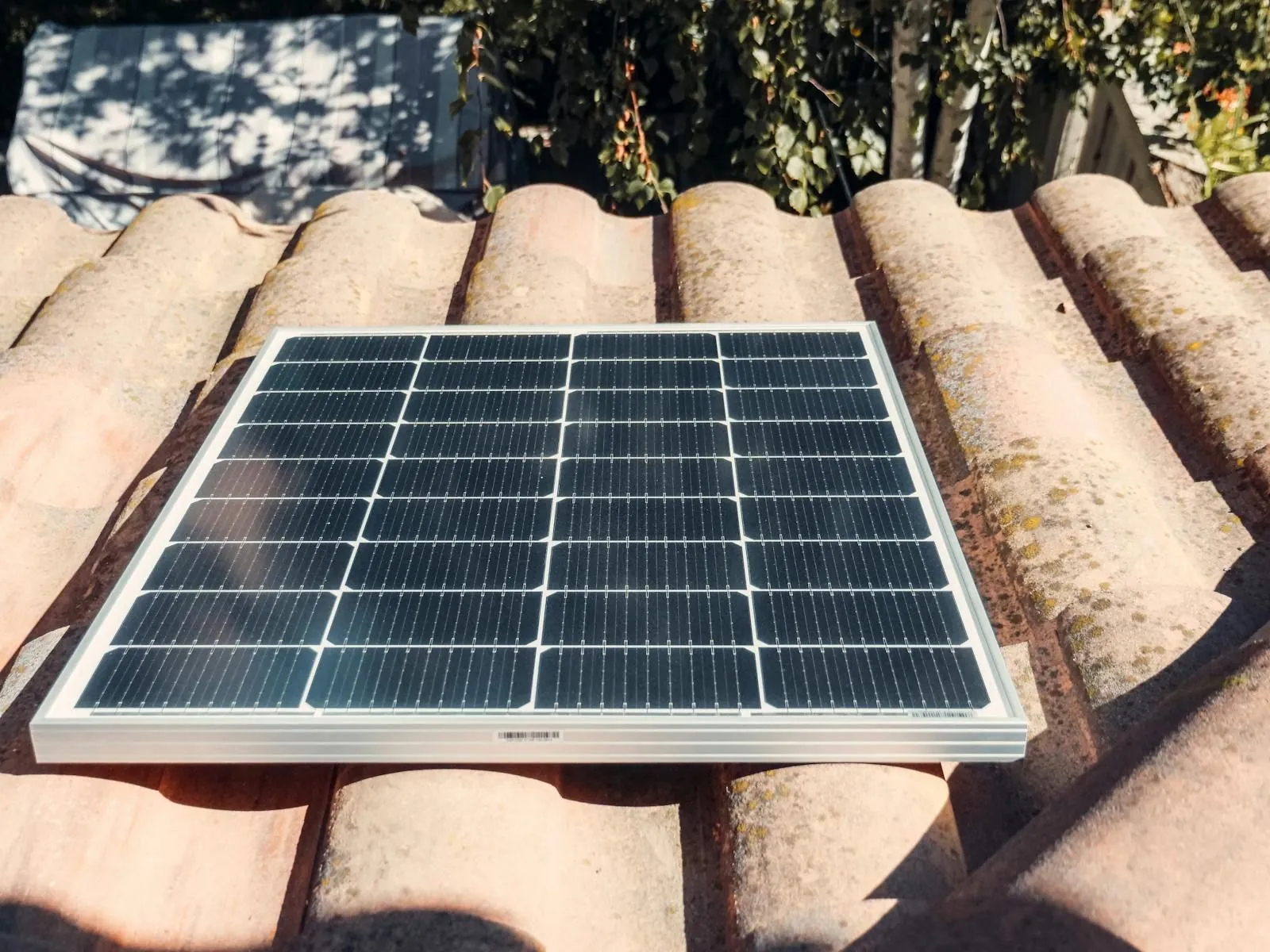
Lightweight vs standard solar panels for commercial buildings
When we run a desk feasibility on a commercial office roof, the first question that decides everything else is structural: how much extra weight can the roof carry? The answer determines whether you fit standard glass-glass panels on ballasted or penetrative mounts, or whether you need a lightweight solar system designed to add a fraction of the load. Getting this wrong is the single most common reason a commercial solar project stalls at the structural survey, so it is worth understanding the trade-offs before you commission anything.
This guide compares lightweight and standard solar panels for commercial buildings on the four factors that actually move a decision: roof loading, installed cost, energy yield, and longevity. It is written for UK office owners, facilities managers and landlords planning a roof-mounted system under BS EN 1991 loading rules.
The core difference: weight on the roof
A conventional commercial PV module is a glass-glass or glass-backsheet panel in an aluminium frame, fixed to either a ballasted mounting system (concrete blocks holding it down against wind uplift) or a penetrative system bolted through the roof membrane. Once you add the mounting structure and ballast, a standard flat-roof array typically imposes 15-25 kg/m² on the roof deck.
Lightweight systems take a different approach. They use thinner-framed or frameless modules, often with an adhesive-bonded or mechanically-clipped mounting that needs little or no ballast. A well-designed lightweight array can come in at 5-10 kg/m², roughly a third to a half of a ballasted standard system. That difference is decisive on roofs that were never engineered to carry additional dead load — older steel-frame offices, large-span warehouse-style roofs, and pre-fabricated or modular structures.
| Factor | Standard glass-glass (ballasted) | Lightweight system |
|---|---|---|
| Roof load added | 15-25 kg/m² | 5-10 kg/m² |
| Mounting | Ballasted or penetrative | Adhesive-bonded or clipped, minimal ballast |
| Module type | Framed glass-glass / glass-backsheet | Thin-frame or frameless |
| Typical cost (GBP/kWp) | 700-900 | 850-1,100 |
| Output per kWp | Baseline (highest) | 90-97% of baseline |
| Warranty (product) | 12-25 years | 10-15 years typically |
| Best for | Sound roofs with spare load capacity | Weak decks, modular and lightweight roofs |
When standard panels are the right call
For the majority of UK commercial offices with a structurally sound flat or low-pitch roof, standard glass-glass panels on a ballasted mount remain the best value. They cost less per kWp installed, deliver the highest energy yield per panel, and come with the longest product and performance warranties — typically a 25-year linear performance guarantee and a 12-25 year product warranty depending on manufacturer.
The condition is straightforward: the roof must be able to carry the load. As part of every feasibility study we commission a structural assessment to BS EN 1991, which models dead load, wind uplift and snow load for your specific building and location. If the survey confirms spare capacity, standard panels almost always win on lifetime cost. They also commission cleanly to IEC 62446 and qualify for the same 100% Annual Investment Allowance in year one as any other plant.
When lightweight panels earn their premium
Lightweight systems carry a modest cost premium — usually 10-20% more per kWp — and give back a few percentage points of yield because frameless or thin-frame modules can run slightly warmer and use marginally less efficient cell layouts. So why pay more for less? Because on the wrong roof, the alternative is no solar at all, or a five-figure structural strengthening bill.
Lightweight solar comes into its own in three situations:
- Roofs at or near their load limit. Older office buildings, particularly steel-portal-frame structures from the 1970s-90s, frequently have little or no spare capacity for ballast. A lightweight system that adds 6 kg/m² instead of 20 kg/m² can be the difference between a feasible project and a rejected one.
- Modular, prefabricated and temporary buildings. Modular offices, cabins and system-built structures are engineered to minimise self-weight, which leaves almost nothing for a ballasted array. This is the classic case for lightweight solar for modular buildings, where a clipped or bonded system works with the roof rather than against it.
- Membrane roofs where penetrations are unwanted. Single-ply membrane roofs under warranty often cannot be drilled without voiding the cover. Adhesive-bonded lightweight mounts avoid penetrations entirely.
If your building falls into any of these categories, our guide to lightweight solar panels for commercial buildings walks through the specific mounting systems and the structural sign-off process in more detail.
How the numbers actually compare
The temptation is to choose on headline cost per kWp alone, but that ignores the structural context. Consider a 200 kWp system on a 1,500 m² office roof:
| Scenario | System type | Indicative install cost | Annual generation | Notes |
|---|---|---|---|---|
| Sound roof, spare capacity | Standard ballasted | GBP 140,000-180,000 | ~180,000 kWh | Lowest cost per unit generated |
| Roof near load limit | Lightweight | GBP 170,000-220,000 | ~170,000 kWh | Avoids strengthening works |
| Roof needs strengthening for standard | Standard + works | GBP 140,000-180,000 + structural | ~180,000 kWh | Strengthening can add GBP 30,000+ |
Once you fold in the cost of structural strengthening that standard panels might require on a marginal roof, lightweight frequently becomes the cheaper total-project route despite the higher panel price. The only way to know which applies to your building is to model both against a real structural assessment. Our solar payback calculator lets you sense-check the savings and payback period for either system size before you commit, and every full feasibility study we run prices both routes side by side where the roof is borderline.
Output and longevity over 25 years
A standard glass-glass module degrades slowly and predictably, typically losing 0.4-0.5% of output per year, leaving it above 85% of original capacity after 25 years. Lightweight modules degrade on a similar curve but tend to carry shorter product warranties (often 10-15 years rather than 25), which matters for a long-hold asset. For an owner-occupier planning to hold the building for two decades, that warranty gap is a real consideration. For a landlord recovering capex through the service charge over a shorter lease horizon, it matters less.
Both system types qualify for the same incentives: 100% first-year Annual Investment Allowance, Smart Export Guarantee payments on exported units, and the EPC uplift that supports MEES 2030 compliance — solar typically adds 4-12 EPC points either way. The choice between lightweight and standard is therefore almost never about the financial incentives and almost always about the roof.
How to decide for your building
The honest answer is that you cannot decide responsibly from a desk without two inputs: a structural assessment to BS EN 1991, and a half-hourly consumption profile from your meter to size the array correctly. We provide both as part of a free 7-day desk feasibility study, then issue a fixed-price proposal that specifies the right system type for your roof — lightweight or standard — with the load calculations attached.
If your roof is sound and has spare capacity, expect us to recommend standard panels and the lowest cost per kWp. If it is older, modular, membrane-covered or load-constrained, expect a lightweight specification that gets you solar without the strengthening bill. Either way, the decision is evidence-led rather than a guess.
Ready to find out which system your building needs? Request your free feasibility study and we will model both options against your actual roof and energy data.